

Apex Camper


Apex Camper
Configure Your Camper
Lead Time: Full details →
Truck Measurements: See what we may need →

Sleeping platform
60″ × 80″
Aluminum pull-out queen, 2.75″ mattress
Fresh water
16–21 gal
16 mid-size / 21 full-size, with level gauge
Inverter
3000W
Shore charger, 2 interior and 1 exterior AC port
Solar
up to 600W
150W/30A MPPT included, up to 600W/50A available
Battery
300Ah
Optional LiFePO4 battery. 5-year warranty.
Pop-Up.
Four seasons.
The Apex is a fully welded aluminum camper with the systems already in it: water, power, heat, and an AC inverter, out of the box. No wood anywhere in the structure, so there is nothing to rot, delaminate, or quietly fail behind a wall three winters from now.
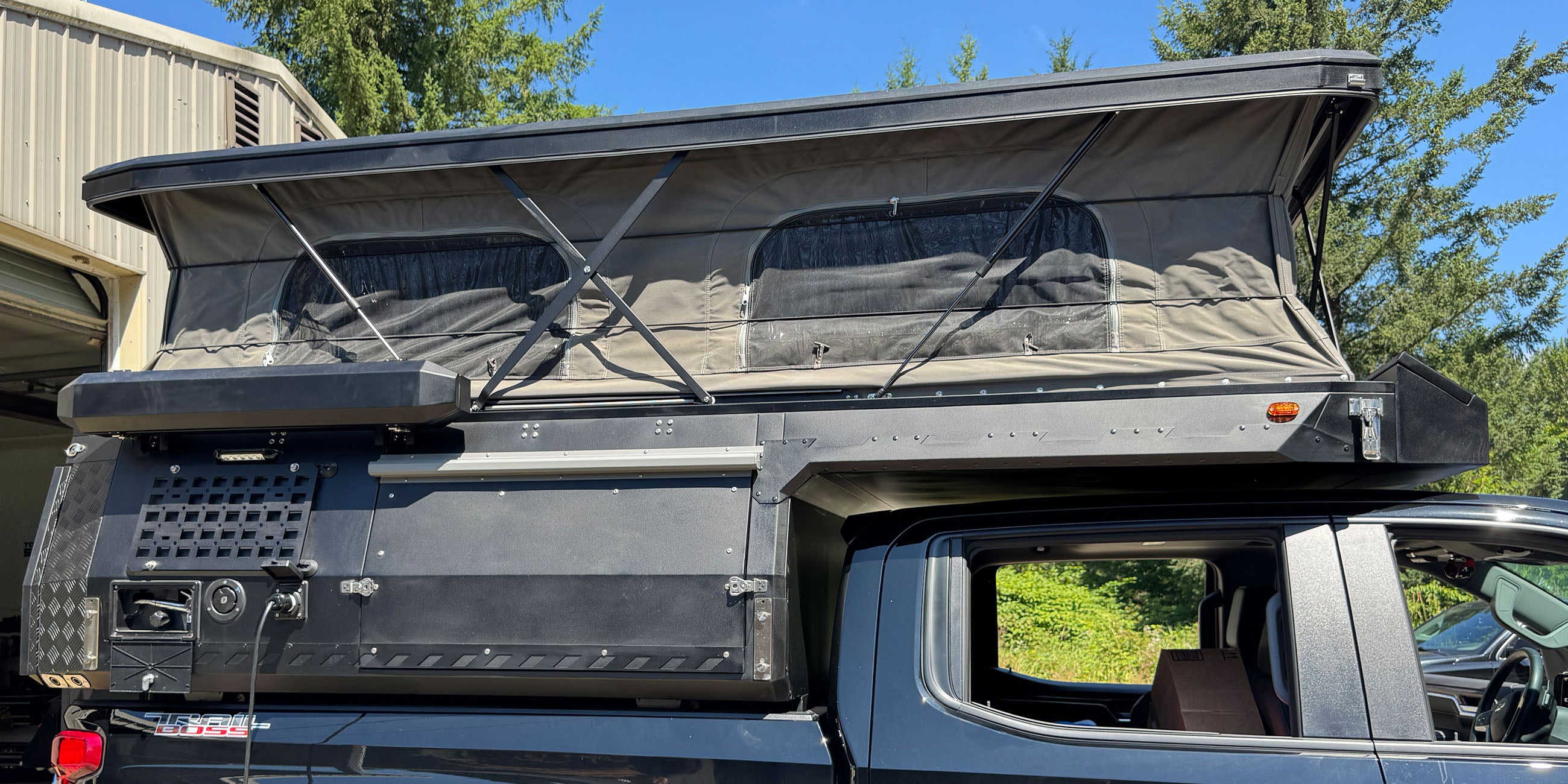
No wood. Nothing to rot.
Four things that make the Apex different
Welded aluminum monocoque
The shell is a fully welded aluminum monocoque, not a framed box with panels hung on it. That eliminates wood entirely: no studs to rot, no substrate to delaminate, no seams relying on sealant to stay structural. It also means the shell carries load as one piece, which is what lets a camper this well equipped stay in its weight class.

Double-thermal insulation, floor to ceiling
One inch of high-density XPS board runs through the body and the floor, and the ceiling gets a thermal-quilted layer. The thermal insulation liner can be removed for hot-weather trips. Combined with an optional diesel or propane heater and an air conditioner, the Apex is genuinely usable in alpine cold and desert heat rather than just rated for it on paper.

A full electrical system, standard
Every Apex ships with a 3000W inverter and shore charger, a 150W solar panel with a 30A MPPT controller, and a 12V control panel with flush buttons, a water level gauge, and a battery meter. Six circuits behind a 100A breaker feed lights, outlets, and other systems. Add a LiFePO4 battery and a 50A DC-DC charger and you have a rig that runs off-grid and tops itself up while you drive.
Space that expands when you park
A passenger-side slide-out comes standard and opens up real storage volume. The driver side carries an aluminum gullwing window with a built-in sunshade and bug mesh that doubles as a second entry and exit point, or it can be swapped for a second slide-out. The dinette table folds down and the bench converts to a second sleeping platform, so a queen bed up top plus the dinette below sleeps a family without anyone climbing over anyone.
See every system before you buy
Real walkthroughs of the systems you will actually use, filmed on a finished camper.
Dinette and bed platform conversion
Control panel walkthrough
Diesel air and water heater
Shore power and inverter explained
Exterior water system
270 awning demonstration
Everything a basecamp needs, already plumbed and wired
A wedge or a pop-up gets you out there. The Apex lets you stay. Sixteen to twenty-one gallons of fresh water with a level gauge and an exterior fill port. A kitchen sink with hot and cold. An exterior shower that quick-connects to either a shower head or a faucet. A 3000W inverter that runs your household appliances and charges the battery the moment you plug into shore power.
The bed is an aluminum pull-out platform at a true 60 by 80 inches, with a 2.75 inch mattress of high-density memory foam over coconut coir. Below it the dinette folds flat into a second berth. Add the interior shower room or the fold-out wet bath with a cassette toilet, and you stop planning trips around where the facilities are.
Quick-connect mechanical jacks, four tie-down straps, and tie-down ratchets are included, so it comes off the truck in your driveway and the truck goes back to being a truck.
Build your ApexDrag to look around. Scroll or pinch to zoom.
Living in it
- How many people does it sleep?
- Up to four. The aluminum pull-out platform is a true queen at 60 by 80 inches with a 2.75 inch memory foam and coconut coir mattress. The dinette table folds down and the bench cushions become a second sleeping platform below. For example, two adults on the queen bed and two kids on the convertible platform. There’s also a few inches of room to leave bedding and pillows on the queen bed platform with the camper closed.
- Can I cook and wash up inside?
- Yes. A kitchen sink with hot and cold water and a folding glass cover is standard, and it can be swapped for a sink and stove combo running propane or 120V AC convection. Full-size trucks can also take a pull-out diesel or propane stove that slides out over the tailgate to cook outside. See the kitchen configurations.
- What about a shower and a toilet?
- An exterior hot and cold shower is standard. Inside, there are three ways to go: a fold-out wet bath with a sink and cassette toilet on beds 6.5 feet and longer, an interior shower room that turns the entry area into a wet area, or the simplest answer, a cassette toilet that stores under the sink and comes out when you need it. See all three.
- Where does everything go?
- Six built-in compartments come standard, a seventh with the driver-side slide-out, and two more on an 8 foot bed. See all of them.
- How does it handle cold?
- One inch of XPS board insulates the body and floor, with a thermal-quilted ceiling on top of it. Heater options run from a 5KW diesel unit up to an Eberspacher AS3 D2L or a Truma VarioHeat propane system, all installed in a rear exterior compartment so the noise and the fuel stay outside the living space. See the heat and climate options.
- How does it handle snow?
- The welded shell and the raised roof panel carry snow without complaint. The limit is the lift mechanism, not the aluminum. Manual lift campers have no lockout, so roughly 400 lbs of accumulation on the roof can force it back down. On a full-size roof that is about 6 inches of settled snow, or as little as 3 to 4 inches of wet spring snow. If you camp where overnight snowfall regularly clears 4 inches, order the electric lift: it includes an automatic lockout that holds the roof up under load. Either way, clear the roof before you raise or lower it.

Roof up, overnightAn owner’s Apex after a night of accumulation. Clear the roof before raising or lowering.

Electric lifting X-braceThe lockout that holds the roof up under load. Remote operated, about 90 seconds up or down.
Pick the look
Cabinet finish, countertop, and flooring are all chosen at order time and they mix freely. These are four combinations we have built.

Straight grain & light grey
- Cabinets
- Wood grain (straight)
- Counters
- Light grey stone
- Floor
- Maple

Straight grain & light grey
- Cabinets
- Wood grain (straight)
- Counters
- Light grey stone
- Floor
- Light oak

Cream grey & marble
- Cabinets
- Cream grey
- Counters
- Marble
- Floor
- Waterproof shower flooring

Natural grain & marble
- Cabinets
- Wood grain (natural)
- Counters
- Marble
- Floor
- Waterproof shower flooring
Three ways to get a bathroom
The standard layout puts the galley where a bathroom would go. There are three ways around that, and they range from giving up the kitchen to giving up nothing at all.
Fold-out wet bath
A real wet bath built into the standard footprint. Nothing overhangs the bed, so the tailgate stays on and the camper still comes off in your driveway the usual way. A sink folds flat against the wall when it is not in use, the floor below it is finished as a wet area with a drain, and there is room for a cassette toilet.
The trade is the kitchen cabinetry: the bathroom takes that wall. You are not left without a kitchen, though. The sink moves into the wet bath and a countertop stove goes on the driver-side cabinetry, so you are still cooking inside.

Folding sinkDrops down when you need it, flat against the wall when you do not.

Wet areaThe full footprint, with space for the cassette toilet.

Driver sideControl panel and countertop stove move here once the bathroom takes the other wall.
6.5 foot beds and longer. On anything under 8 feet the control panel has to move to the driver side, which makes the vertical fridge your only refrigeration option. The pull-out stove is not compatible with this layout on any bed length, since it lives in the cabinetry run the bathroom replaces. See the fridge options.
Just a cassette toilet
Most owners skip the full wet bath anyway. A cassette toilet covers the important half of a bathroom, and there are two ways to do it: a portable that stores under the sink and works on any build, or a permanent unit that installs at the factory as part of the wet bath. Pair either with the standard exterior shower and you have both ends of the problem handled.

Thetford Porta Potti 335Portable, and available on any build. Stores under the sink, comes out when you need it, goes away when you do not. Small, inexpensive, and it just works.

Dometic CTW 4110Permanently installed and hardwired for 12V. Ceramic-lined bowl, 1.8gal flush tank, 5gal wheeled waste cassette that pulls out for emptying.
The CTW 4110 is the one we recommend if you want a toilet that feels like a toilet rather than a piece of camping gear. It is a permanent toilet and it requires the fold-out wet bath, so it is not something we can retrofit or fit into a standard layout. The seat swivels up to 90 degrees in either direction in 15 degree steps so it fits a tight corner, and the waste cassette has wheels and a telescopic handle for carrying to a dump station. It measures roughly 26.5 by 15 by 21 inches and weighs about 27.5 lbs empty. The 1.8gal flush tank is filled by hand, so it can be filled in the sink or with the exterior water system.
Shower inside instead of out
If you'd rather not stand outside in a towel, the interior shower "room" turns the entry galley area into a wet area: waterproof flooring, a floor drain, a shower head that connects at the kitchen sink, and a shower curtain on a ceiling track that comes down and stores away when you are not using it.
This one stacks rather than replaces. Unfortunately it won't work with the Dometic CTW 4410, but it can still work with a basic portable toilet like the Thetford Porta Potti 335.

Waterproof floorThe drain sits at the entry area, so the water goes where you want it.
Three ways to configure the galley
The sink is standard. What you cook on is up to you, and the answer changes depending on whether you want to cook inside, outside, or both.

Sink only, standardHot and cold water with a folding glass cover that gives you the counter back when you are done.

Sink and stove comboPropane burner or 120V AC convection, in the same footprint, under the same folding cover.

Pull-out stoveDiesel or propane, installed under the kitchen cabinet, slides out over the tailgate to cook outside.
Cooking inside
The sink and stove combo is the one to pick, or bring your own portable cooktop and keep the plain sink. It keeps the whole galley in one footprint and the folding glass cover means you are not giving up counter space to have a burner. Choose propane if you are already planning on running a tank, or 120V AC convection if you would rather stay fuel-free inside and run it off the inverter.
Cooking outside
The pull-out stove mounts under the kitchen cabinet and slides out over the tailgate, so the smoke, the smell, and the heat stay outside. Full-size trucks only, since it needs the cabinet depth. It is also the only option that runs on diesel, which matters if you are trying to avoid carrying propane.
Both, or neither
Nothing stops you running the combo unit inside and the pull-out outside on the same build. On the other end, plenty of owners keep the plain sink and cook on a camp stove on the tailgate or on the kitchen countertop. That is the lightest and cheapest answer and it works.
The pull-out stove requires a full-size truck and is not compatible with the fold-out wet bath, since it lives in the cabinetry run the bathroom replaces. See the bathroom options.
Portable or built-in
This is a real fork in the road rather than a spec upgrade. A portable comes out of the camper. A vertical unit is cabinetry. Pick based on how you camp, not on the liter count.

Alpicool 55L portableTop-opening, dual-zone, lifts out, sets up outside at camp.

ICECO VL60ProSThe same idea in a different build quality and price bracket.

Alpicool 50L verticalFront-opening, built into the cabinetry, dual-zone. Dometic CRX-50 upgrade available.
Portable
Lifts out of the camper entirely, which buys back interior seating space at camp and lets you take the cold food to the picnic table instead of walking back and forth. Top-opening lids are easier to dig through without everything falling out. The trade is that it does not look built-in, and you lose the countertop you would have had on top of a vertical unit.
Vertical, built-in
Looks like it belongs there, because it does. Dual-zone models give you a real freezer alongside the fridge, and the counter installed on top is usable space you do not get otherwise. The trades: less total usable volume for the space it occupies, front-opening shelves that suit some packing styles and frustrate others, no option to take it outside, and form-fit cabinetry that makes swapping it later a project rather than a purchase.
Bring your own
If you already own a fridge you like, or you want a brand we do not stock, that is usually workable. Send us the exact model and outside dimensions and we will check it against your build before we cut cabinetry. Worth asking early rather than after the drawing is signed off.
One constraint worth knowing: if you are ordering the fold-out wet bath on a bed under 8 feet, the vertical fridge is your only option. See why.
Where everything goes
Storage is at a premium in the Apex, and that is a design decision rather than an oversight. The camper is built to stay narrow, low, and off-road capable, which costs interior volume that a traditional hard-wall camper keeps. What you get instead is a rig that goes where those campers cannot. Here is every compartment, including the ones that look like storage and are not.
Standard on every build

Under the fridgeDriver side, below the fridge position.

Kitchen drawerThe one you will use every day. Utensils, tools, the small stuff.

Under the kitchen sinkHas an exterior access hatch. Taken by the pull-out stove if you order one.

Dinette, driver sideUnder the gullwing window, reachable from the bench.

Inside the slide-outThe big one. Only reachable with the slide-out extended, so pack it accordingly.

Front spoiler, exteriorDrain holes in the floor, so it takes wet gear without you thinking about it. Dry gear works too.
A few spaces look like storage and usually are not. The floor compartment under the dinette holds the fresh water tank, and the passenger side of the dinette holds the battery and electronics. Neither is ever available. The two rear exterior compartments are a maybe: they are normally taken by the air and water heaters, but the Eberspacher combo is compact enough that both units fit in the larger passenger side compartment, which leaves the smaller driver side one open for gear.
Two more on an 8 foot bed
The extra floor length on an 8 foot build goes into cabinetry rather than empty space.

Below the bed platformCabinets in the dinette area, under the pull-out queen.

Galley cabinetryAdditional cabinets in the fridge and galley run.
If storage is your constraint, the driver-side slide-out is the single biggest thing you can add, and it is the option we point people to most often. Dimensions and capacity for every compartment vary with your truck bed, since the camper is built to your measurements. Exact numbers come with your CAD drawing. See how that works.

Living with it
- Can my truck handle the weight?
- Pick your options and enter your payload in the weight calculator and it will tell you.
- How does it come on and off?
- Quick-connect mechanical camper jacks are included, along with four tie-down points and ratchet straps. Jack it up, drive the truck out, and lower it onto stands. No drilling, no permanent modification. Watch the installation video.
- How much force does the roof take?
- Manual push-up with pull-down handles is standard and takes roughly 150 lbs of force until the struts engage. If you are adding a roof air conditioner or roof rack, go with electric lifting: it runs off a remote, takes about 90 seconds, and adds an automatic lockout that holds the roof up under snow load. It is not a requirement but it is recommended. The pop-up portion can still be opened and closed manually as well. See the lifting mechanism.
- Will it fit my truck?
- The Apex is built to your bed length. Some trucks need a couple of quick measurements to guarantee the fit, and if yours does, we will reach out after you order. See what we may need.
What’s under the hood
Four systems carry the camper: the welded shell, the power and control side, the battery bay, and solar. Water, heat, and climate get their own sections below.
 Welded assembly, in production
Shell & structure
- Fully welded aluminum monocoque, zero wood in the structure
- 1″ high-density XPS board insulation through body and floor
- Thermal-quilted ceiling insulation, removable for service
- Flame-retardant, environmentally friendly insulation package
- Quick-connect mechanical jacks, 4 tie-down points, ratchet straps included
 Control panel
Power & control
- 3000W inverter with shore charger, 2 interior and 1 exterior AC port
- 12V control panel with flush buttons, water level gauge, and battery meter
- 6 DC circuits behind a 100A breaker and a GFCI 20A AC breaker for safety
- Wireless-controlled interior LEDs, 3 exterior floodlights, 6 marker lights, brake light
- Vehicle harness included for trailer brake and running lights
 Battery bay (2026)
Battery & charging
- Battery compartment under the passenger-side bench, new for 2026
- 150W solar and 30A MPPT standard, up to 600W with a 50A controller
- Optional Renogy 50A DC-DC charger, terminated at an Anderson plug up front
- Shore charging and auto-switching through the inverter the moment you plug in
- LiFePO4 battery sold separately in the configurator
 600W package, four 150W panels
Solar
- OEM-grade panels, the same ones major manufacturers use
- High-efficiency monocrystalline cells at 22 to 23% conversion
- Flush, no-drill mounting that leaves the roof seal intact
- All panels wired to a single sealed entry point
- 150W standard, 450W and 600W packages available
Every hole in a roof is a leak waiting to happen, so the array is wired to one sealed pass-through rather than one per panel. Going from 150W to 600W adds panels, not penetrations. The Renogy 50A DC-DC charger has a 50A MPPT controller built in; without it, the array runs on a standalone MPPT.
Plumbed, inside and out
Fresh water tank, a pump, and an exterior water port are all standard.

Fresh water tankUpgraded for 2026. Sits under the dinette with an exterior fill port and a level gauge on the control panel.

Exterior portQuick-connects to either a shower head or a faucet. Pairs with the optional shower awning. The fill port sits next to it.
Inside, the kitchen sink runs hot and cold on a folding faucet so the glass cover still closes flat over it. The 12V pump is included and genuinely quiet, with an on and off switch right on the control panel rather than buried in a cabinet. Whether you get hot water at either point depends on which water heater you choose. See the water heater options.
Choosing your fuel
Heat, hot water, and air conditioning are the three options that interact with each other more than anything else on the build sheet. Pick them together rather than one at a time.
Hot water
Both options give you hot water at the kitchen sink and the exterior shower port. They get there very differently.

Eberspacher dieselCirculating design. Runs for a few minutes, then hot water on demand.

PropaneBurner-fired and tank-holding. Simple hot water solution.
We recommend the diesel water heater. It circulates antifreeze through a heat exchanger, so you switch it on, wait a few minutes, and then have hot water on demand for as long as you want it. The propane unit fires its burner when you call for hot water, which means you run water down the drain waiting for it to come up to temperature. The diesel unit is also easier to winterize, because the thing holding water is just the heat exchanger rather than a tank inside the heater itself. Both options have to be winterized, and freeze damage is not covered under warranty.
Cabin heat
All three install in the rear passenger side exterior compartment, so the burner noise and the fuel stay outside the living space.

Standard 5KW dieselThe baseline. More than enough heat for the volume, and cheap to run.

Eberspacher dieselThe upgrade. Pairs with the diesel water heater on a single shared control panel. Pictured with the air heater installed in the same compartment.

Truma VarioHeat propaneThe way to build a diesel-free camper if that is what you are after.
We recommend the Eberspacher air and water combination. The two units share one control panel, which is a real quality of life difference when you are half asleep and cold, and they are the premium pieces of hardware in the lineup. The Eberspacher and the Truma VarioHeat both have a built-in thermostat, so they kick on automatically when the camper drops below your set point. The Eberspacher pair is also compact enough to share the larger passenger side rear compartment, which frees up the driver side one for exterior storage.
Air conditioning

Roof mounted · 8,360 BTUStandard roof mounted option.

Dometic FreshJet 5 · 15,000 BTUPremium roof option. Nearly double the output.

Rear mounted · 6,800 BTULeaves the roof clear for full solar. Control panel above the kitchen sink.
What BTU means. BTU per hour is how much heat the unit pulls out of the camper in an hour. Higher cools a hotter space faster and holds temperature in more extreme heat. For a camper this size, 6,000+ BTU keeps you comfortable in most conditions.
Electric lifting is strongly recommended with either roof mounted unit. A roof mounted air conditioner adds 85 to 95 lbs to the top, and you feel all of it in the first few inches of travel. The struts do most of the work once they engage, but you have to push the top up under your own strength until they take over. A strong, capable person can manage it manually.
Air conditioning is the heaviest draw in the camper: expect roughly 9 hours on low or 5 to 6 on medium overnight, and near break-even during the day when solar output peaks alongside the heat. One constraint worth knowing before you choose: the rear mounted unit takes the rear passenger side compartment, which pushes the heater over to the driver side. That compartment is smaller, only fits the 3KW standard diesel unit, and stops being available for storage. The heater price does not change, but the pairing does, so if you want the Eberspacher combination you want the roof mounted air conditioner.
A propane-free camper
Run the Eberspacher diesel air and water heaters, and cook on either the 120V AC convection combo or a diesel pull-out stove. No tank to refill, nothing to swap out on a holiday weekend, and one less thing to store.
A diesel-free camper
Run the Truma VarioHeat propane heater with the propane water heater, and cook on a propane pull-out stove or the propane sink and stove combo. Everything on one fuel, one tank.
Roof mounted air conditioning, Eberspacher diesel air and water
If you asked us to spec one Apex and hand it to you, this is the heat and climate configuration we would build.
Diesel is more effective per unit of fuel and a tank lasts considerably longer, which matters most on exactly the kind of trip where refilling is inconvenient. Running the Eberspacher pair means the camper has one fuel source and no propane tank to store, refill, or swap on a holiday weekend. The two units share a single control panel, which is a real quality of life difference when you are half asleep and cold, and they are the premium hardware in the lineup.
Putting the air conditioner on the roof is what makes that pairing possible. The rear mounted unit takes the passenger side compartment and pushes the heater to the smaller driver side one, which limits you to the 3KW standard diesel heater and costs you an exterior storage compartment. Going up top keeps both rear compartments doing what they should: the Eberspacher pair on one side, storage on the other.
Propane is still the better answer if you want the simplest possible system, or if you have a sensitivity to diesel fumes. And the rear mounted air conditioner is the right call if you want the roof clear for a full solar array. Neither is a downgrade, they are just different priorities.
Loading it on the truck
Jacks, tie-downs, and straps, start to finish. It comes off in your driveway the same way it goes on.
Every Apex is drawn before it is built
There is no fixed model list. We size the camper to your truck, confirm the interior layout and the exterior dimensions with you in CAD, and only then does it go into the build queue. What you sign off on is what shows up.

Your build, renderedWe model the interior so you can see the layout and the finishes before the shell is welded.

InteriorExample dimensions for a 2026 Silverado 1500 with a 6.5-ft box.

ExteriorExample dimensions for a 2023 F250 with a 6.75-ft box.
Any truck, any bed
Short bed, long bed, mid-size, full-size, or a flatbed. We build to the measurements, not to a catalog of pre-set models. If your truck is unusual, that is a drawing problem rather than a dealbreaker.
Fits more than one vehicle
Planning to move the camper between trucks, or thinking about your next one? Tell us both and we will dimension it to work on either. It is easier to design for at the start than to retrofit later.
Shell only, for DIY builds
If you would rather build your own interior, we can supply just the welded shell with the pop-up top and full insulation package. You add the cabinetry, the systems, and the layout you want. Contact us for shell pricing.
Weight calculator
Bed length
Power & electrical
Heating & water
Kitchen & refrigeration
Climate control
Shelter & exterior
Structure & storage
Bath & sanitation
Fill it up
Dry weight, pounds
These are our build weights, accurate to within a few pounds. What is left after you subtract the camper is what you have for passengers, gear, fuel, water you add later, and anything in the truck bed.
$18,995 gets you all of this
12V system
Control panel, water level gauge, and battery meter. 4 USB and 2 DC outlets, 2 reading lights. Wireless-controlled interior LEDs. Exterior USB & DC outlet.
3000W inverter
Shore charger built in, 2 interior AC ports and 1 exterior AC port.
150W solar
Panel and 30A MPPT controller, upgradeable to 450W or 600W.
Water system
16 to 21 gallon tank, pump, level gauge, and exterior fill port.
Kitchen sink
Hot and cold water with a folding glass cover for extra counter space.
Exterior shower
Hot and cold port with quick-connect shower head and faucet. Shower awning optional.
Queen sleeping platform
Aluminum pull-out platform, 60″ × 80″, with a 2.75″ memory foam and coconut coir mattress.
Double-thermal insulation
1″ XPS board through body and floor, thermal-quilted ceiling, fully removable.
Passenger slide-out
Standard single slide-out for storage. A driver-side slide-out can be added.
Gullwing window
Driver-side aluminum gullwing with sunshade and bug mesh, doubles as an entry point.
Convertible dinette
Foldable table with bench seating that converts to a second sleeping platform.
Camper jacks
Quick-connect mechanical jacks, 4 tie-down points, and ratchet straps.
Exterior lighting
3 LED floodlights, 6 marker and running lights, brake light, and a vehicle wiring harness.
Ventilation fan
Standard roof fan with light and reversible airflow. Maxxfan Plus available.
The wiring harness to your vehicle’s trailer brake and running lights is included, but installation is not. Battery sold separately.
Four thousand miles home

★★★★★
We picked up our Apex on a Sunday! John and Eddy were kind enough to take half a day away from family and spend it going through everything with us. We camped all the way back to Texas with multiple stops to visit National Parks along the way. 12 days on the road and approximately 4000 miles to break it in. We really enjoyed the freedom and scenery that camping gave us versus hotel stays every night going out to get the Apex, not to mention the money saved. We have another trip of approximately 15 days planned for next month that we are really looking forward to in our Apex. Very pleased so far with the service John and Eddy have given us, and we believe the value the Apex has shown us is top notch. Highly recommend researching the Apex if you’re looking for a great pickup camper to hit the road with.
Steve
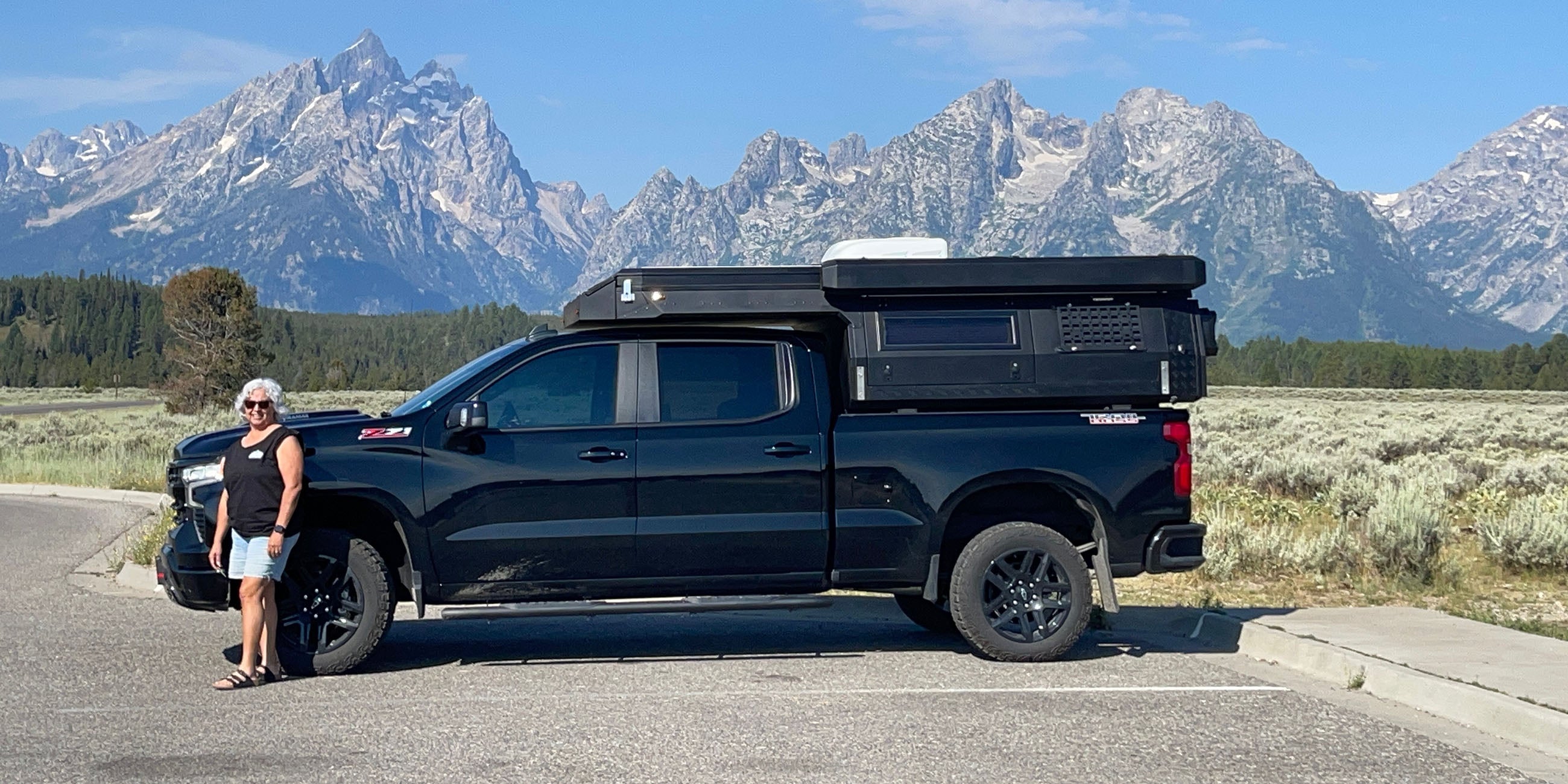
Ready to build yours?
Pick your options, place a deposit, and we will build it to your bed length. Current lead time is on the lead times page.
Before you order
What is the lead time?
Lead times move with the build queue. The lead times page is always current.
Can I finance it?
Yes. Options start as low as 0% APR subject to approval, and pre-qualification takes a few minutes. Financing details.
Will it fit my payload?
Depends on your truck and your options. The weight calculator works it out against your door jamb sticker in about a minute.
Do the water systems need winterizing?
Yes. Water heaters in particular have to be winterized. Freeze damage from skipping it is not covered under warranty.